# TenantResources
> Replicate resources across a Tenant's Namespaces as Tenant Owner
> For the complete documentation index, see [llms.txt](https://deploy-preview-156--docs-projectcapsule.netlify.app/llms.txt).
> The HTML version of this page is at https://deploy-preview-156--docs-projectcapsule.netlify.app/docs/replications/tenant/.
## Overview
`TenantResource` is a namespace-scoped CRD that lets Tenant owners automatically replicate Kubernetes resources across all Namespaces in their Tenant - without manual distribution or custom automation. It is the tenant-level counterpart to [GlobalTenantResource](/docs/replications/global/), which is reserved for cluster administrators.
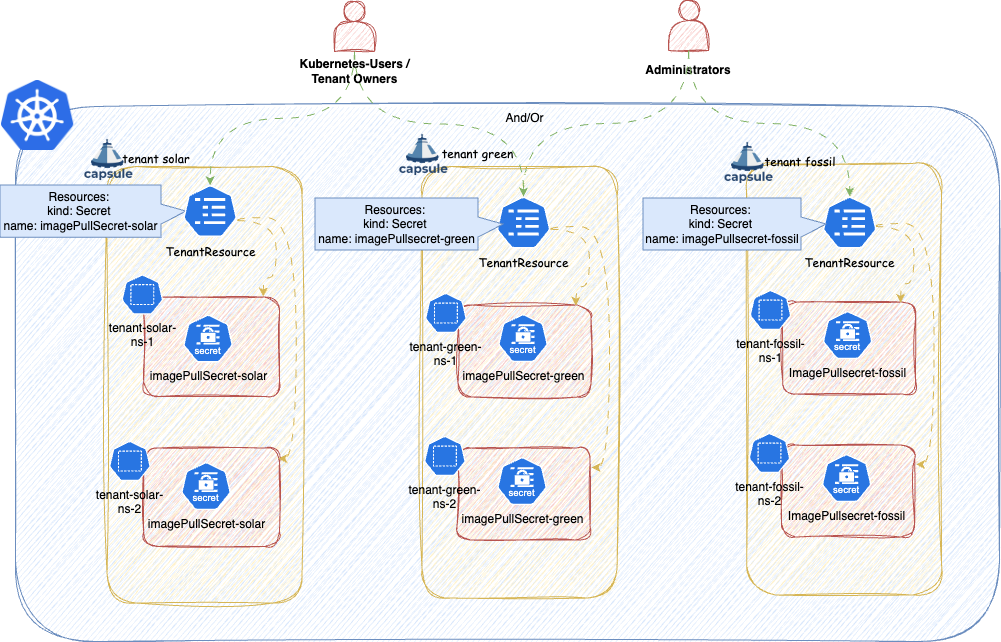
The diagram below shows that an Administrator or a Tenant Owner can create a `TenantResource` inside a `Tenant`. In the `TenantResource` spec, a user specifies which resource they would like to replicate across the `Tenant`. When applied, this resource gets automatically distributed across all Namespaces that are part of the `Tenant`.
> **OpenShift: etcd Encryption**
>
> If you are running on OpenShift with etcd encryption enabled and replicating ConfigMaps or Secrets, you must exclude the OpenShift storage version migrator from the replication webhook. Without this, the migrator cannot rotate encryption keys. See the OpenShift installation guide for the required configuration.
## Prerequisites
Tenant owners must have RBAC permission to create, update, and delete `TenantResource` objects. The following `ClusterRole` aggregates to the `admin` role, granting all holders permission to manage `TenantResource` instances:
```yaml
apiVersion: rbac.authorization.k8s.io/v1
kind: ClusterRole
metadata:
name: allow-tenant-resources
labels:
rbac.authorization.k8s.io/aggregate-to-admin: "true"
rules:
- apiGroups: ["capsule.clastix.io"]
resources: ["tenantresources"]
verbs: ["get", "list", "watch", "create", "update", "patch", "delete"]
```
## Example
Alice, the project lead for the `solar` tenant, wants to provision a PostgreSQL database for each production Namespace automatically:
```bash
$ kubectl get namespaces -l capsule.clastix.io/tenant=solar --show-labels
NAME STATUS AGE LABELS
solar-1 Active 59s capsule.clastix.io/tenant=solar,environment=production,kubernetes.io/metadata.name=solar-1,name=solar-1
solar-2 Active 58s capsule.clastix.io/tenant=solar,environment=production,kubernetes.io/metadata.name=solar-2,name=solar-2
solar-system Active 62s capsule.clastix.io/tenant=solar,kubernetes.io/metadata.name=solar-system,name=solar-system
```
She creates a `TenantResource` in `solar-system`:
```yaml
apiVersion: capsule.clastix.io/v1beta2
kind: TenantResource
metadata:
name: solar-db
namespace: solar-system
spec:
resyncPeriod: 60s
resources:
- additionalMetadata:
labels:
"replicated-by": "capsule"
namespaceSelector:
matchLabels:
environment: production
rawItems:
- apiVersion: postgresql.cnpg.io/v1
kind: Cluster
metadata:
name: "postgres-{{namespace}}"
spec:
description: PostgreSQL cluster for the {{tenant.name}} Project
instances: 3
postgresql:
pg_hba:
- hostssl app all all cert
primaryUpdateStrategy: unsupervised
storage:
size: 1Gi
```
Capsule replicates the `Cluster` resource into every Namespace matching the `namespaceSelector`. The Namespace where the `TenantResource` itself lives (`solar-system`) is automatically excluded, and Capsule injects labels to prevent the `TenantResource` from propagating into unowned Namespaces.
```bash
$ kubectl get clusters.postgresql.cnpg.io -A
NAMESPACE NAME AGE INSTANCES READY STATUS PRIMARY
solar-1 postgres-solar-1 80s 3 3 Cluster in healthy state postgresql-1
solar-2 postgres-solar-2 80s 3 3 Cluster in healthy state postgresql-1
```
> Objects managed by this controller can be either **created** (new objects) or **adopted** (existing objects). See [Object Management](#object-management) in the Advanced section for full details.
---
## Basic Usage
### Resources
A resource block defines *what* to replicate. Multiple blocks can be stacked in the `resources` array, each using one or more of the strategies below.
#### NamespaceSelector
The `namespaceSelector` field restricts replication to Namespaces matching a label selector. Capsule also protects selected resources from modification by Tenant users via its webhook.
#### AdditionalMetadata
Use `additionalMetadata` to attach extra `labels` and `annotations` to every generated object. [Fast Template values](/docs/operating/concepts/templating/#fast-templates) are supported:
```yaml
---
apiVersion: capsule.clastix.io/v1beta2
kind: TenantResource
metadata:
name: tenant-cluster-rbac
spec:
scope: Tenant
resources:
- additionalMetadata:
labels:
k8s.company.com/tenant: "{{tenant.name}}"
annotations:
k8s.company.com/cost-center: "inv-120"
generators:
- missingKey: error
template: |
---
apiVersion: rbac.authorization.k8s.io/v1
kind: ClusterRole
metadata:
name: tenant:{{$.tenant.metadata.name}}:priority
labels:
k8s.company.com/tenant: "test"
rules:
- apiGroups: ["scheduling.k8s.io"]
verbs: ["get"]
resources: ["priorityclasses"]
```
When the same label key appears in both `additionalMetadata` and the template, `additionalMetadata` takes priority.
The following labels are always stripped because they are reserved for the controller:
* `capsule.clastix.io/resources`
* `projectcapsule.dev/created-by`
* `capsule.clastix.io/managed-by`
* `projectcapsule.dev/managed-by`
#### NamespacedItems
Reference existing resources for replication across Tenant Namespaces. The controller validates that any resource kind listed here is namespace-scoped; cluster-scoped kinds are rejected with an error.
```yaml
---
apiVersion: capsule.clastix.io/v1beta2
kind: TenantResource
metadata:
name: tenant-resource-replications
spec:
resyncPeriod: 60s
resources:
- namespacedItems:
# Replicate all Configmaps labeled with projectcapsule.dev/replicate: "true"
- apiVersion: v1
kind: ConfigMap
selector:
matchLabels:
projectcapsule.dev/replicate: "true"
# Replicate all Configmaps labeled with projectcapsule.dev/replicate: "true" and in namespace capsule-system
- apiVersion: v1
kind: ConfigMap
namespace: capsule-system
selector:
matchLabels:
projectcapsule.dev/replicate: "true"
# Replicate Configmap named "logging-config" in namespace capsule-system labeled with projectcapsule.dev/replicate: "true" and in namespace capsule-system
- apiVersion: v1
kind: ConfigMap
name: logging-config
namespace: capsule-system
```
**Note**: Resources with the label `projectcapsule.dev/created-by: resources` are ignored by `namespacedItems` to prevent reconciliation loops.
If you try to define a cluster-scoped resource under `namespacedItems`, the reconciliation will fail immediately:
```yaml
---
apiVersion: capsule.clastix.io/v1beta2
kind: TenantResource
metadata:
name: tenant-resource-replications
spec:
resyncPeriod: 60s
resources:
- namespacedItems:
- apiVersion: addons.projectcapsule.dev/v1alpha1
kind: SopsProvider
name: infrastructure-provider
optional: true
status:
conditions:
- lastTransitionTime: "2026-01-15T21:04:15Z"
message: cluster-scoped kind addons.projectcapsule.dev/v1alpha1/SopsProvider is
not allowed
reason: Failed
status: "False"
type: Ready
```
##### Name
Providing `name` triggers a `GET` request for that single resource rather than a `LIST`:
```yaml
---
apiVersion: capsule.clastix.io/v1beta2
kind: TenantResource
metadata:
name: tenant-resource-replications
namespace: wind-test
spec:
resyncPeriod: 60s
resources:
- namespacedItems:
# Fetch ConfigMaps labeled with the tenant name and replicate them into each Tenant Namespace
- apiVersion: v1
kind: ConfigMap
name: "logging-config"
```
This distributes the `ConfigMap` named `logging-config` to all other Namespaces of the Tenant that `wind-test` belongs to.
[Fast Templates](/docs/operating/concepts/templating/#fast-templates) are supported for `name`, `namespace`, and `selector`.
##### Namespace
Providing only `namespace` performs a `LIST` of all resources of that kind in that namespace:
```yaml
---
apiVersion: capsule.clastix.io/v1beta2
kind: TenantResource
metadata:
name: tenant-resource-replications
spec:
resources:
- namespacedItems:
- apiVersion: v1
kind: ConfigMap
name: config-namespace
optional: true
```
[Fast Templates](/docs/operating/concepts/templating/#fast-templates) are supported for the `namespace` property:
```yaml
---
apiVersion: capsule.clastix.io/v1beta2
kind: TenantResource
metadata:
name: tenant-resource-replications
spec:
resyncPeriod: 60s
resources:
- namespacedItems:
# Fetch ConfigMaps labeled with the tenant name and replicate them into each Tenant Namespace
- apiVersion: v1
kind: Secret
namespace: "{{tenant.name}}-system"
```
##### Selector
When using `selector`, the selector labels are stripped from the replicated objects. This prevents the replicated copy from also matching the source selector, which would cause a circular reconciliation loop.
Source `ConfigMap`:
```yaml
---
apiVersion: v1
kind: ConfigMap
metadata:
name: app-config
labels:
projectcapsule.dev/replicate: "true"
namespace: wind-test
data:
player_initial_lives: "3"
ui_properties_file_name: "user-interface.properties"
```
`TenantResource`:
```yaml
---
apiVersion: capsule.clastix.io/v1beta2
kind: TenantResource
metadata:
name: app-config
spec:
resources:
- namespacedItems:
- apiVersion: v1
kind: ConfigMap
selector:
matchLabels:
projectcapsule.dev/replicate: "true"
```
Resulting object in `wind-prod` (notice the absence of `projectcapsule.dev/replicate`):
```yaml
apiVersion: v1
data:
player_initial_lives: "3"
ui_properties_file_name: "user-interface.properties"
kind: ConfigMap
metadata:
labels:
projectcapsule.dev/created-by: resources
projectcapsule.dev/managed-by: resources
name: app-config
namespace: wind-prod
resourceVersion: "784529"
uid: 5f10a3f3-863e-4f45-9454-cff8f5bce86a
```
[Fast Templates](/docs/operating/concepts/templating/#fast-templates) are supported for `selector`:
```yaml
---
apiVersion: capsule.clastix.io/v1beta2
kind: TenantResource
metadata:
name: tenant-resource-replications
spec:
resyncPeriod: 60s
resources:
- namespacedItems:
# Fetch ConfigMaps labeled with the tenant name and replicate them into each Tenant Namespace
- apiVersion: v1
kind: ConfigMap
selector:
matchLabels:
company.com/replicate-for: "{{tenant.name}}"
```
#### Raw
Raw items let you define resources inline as standard Kubernetes manifests. Use this when the resource does not yet exist in the cluster, or when you want to define it directly in the spec. [Fast Templates](/docs/operating/concepts/templating/#fast-templates) are supported.
```yaml
---
apiVersion: capsule.clastix.io/v1beta2
kind: TenantResource
metadata:
name: tenant-resource-replications
spec:
resyncPeriod: 300s
resources:
- rawItems:
- apiVersion: v1
kind: LimitRange
metadata:
name: "{{tenant.name}}-{{namespace}}-resource-constraint"
spec:
limits:
- default: # this section defines default limits
cpu: 500m
defaultRequest: # this section defines default requests
cpu: 500m
max: # max and min define the limit range
cpu: "1"
min:
cpu: 100m
type: Container
```
The following example creates a [`SopsProvider`](https://github.com/peak-scale/sops-operator) for each Tenant:
```yaml
---
apiVersion: capsule.clastix.io/v1beta2
kind: TenantResource
metadata:
name: tenant-sops-providers
spec:
resyncPeriod: 600s
scope: Tenant
resources:
- rawItems:
- apiVersion: addons.projectcapsule.dev/v1alpha1
kind: SopsProvider
metadata:
name: "{{tenant.name}}-secrets"
spec:
keys:
- namespaceSelector:
matchLabels:
capsule.clastix.io/tenant: "{{tenant.name}}"
sops:
- namespaceSelector:
matchLabels:
capsule.clastix.io/tenant: "{{tenant.name}}"
```
Because [Server-Side Apply](https://kubernetes.io/docs/reference/using-api/server-side-apply/) is used, you only need to specify the fields you want to manage - the full resource spec is not required.
For more advanced templating, consider [Generators](#generators).
#### Generators
Generators render one or more Kubernetes objects from a Go template string. The template content must be valid YAML; multi-document output separated by `---` is supported. The template engine is based on [go-sprout](https://github.com/go-sprout/sprout) - see [available functions](/docs/operating/concepts/templating/#sprout-templating).
A simple example that creates a `ClusterRole` per Tenant:
```yaml
---
apiVersion: capsule.clastix.io/v1beta2
kind: TenantResource
metadata:
name: tenant-cluster-rbac
spec:
resources:
- generators:
- missingKey: error
template: |
apiVersion: rbac.authorization.k8s.io/v1
kind: ClusterRole
metadata:
name: tenant:{{$.tenant.metadata.name}}:reader
rules:
- apiGroups: [""]
resources: ["secrets"]
verbs: ["get", "watch", "list"]
```
Templates can also produce multiple objects using flow control:
```yaml
---
apiVersion: capsule.clastix.io/v1beta2
kind: TenantResource
metadata:
name: tenant-priority-rbac
spec:
scope: Tenant
resources:
- generators:
- missingKey: error
template: |
{{- range $.tenant.status.classes.priority }}
---
apiVersion: rbac.authorization.k8s.io/v1
kind: ClusterRole
metadata:
name: tenant:{{$.tenant.metadata.name}}:priority:{{.}}
rules:
- apiGroups: ["scheduling.k8s.io"]
resources: ["priorityclasses"]
resourceNames: ["{{.}}"]
verbs: ["get"]
{{- end }}
```
See [Base Context](#base-context) for available template variables. To load additional resources into the template context, see [Context](#context) in the Advanced section.
##### Template Snippets
Some snippets that might be useful for certain cases.
###### Names
Extract the `Tenant` name:
```html
{{ $.tenant.metadata.name }}
```
Extract the `Namespace` name:
```html
{{ $.namespace.metadata.name }}
```
###### Foreach Owner
Iterate over all owners of a Tenant:
```html
{{- range $.tenant.status.owners }}
{{ .kind }}: {{ .name }}
{{- end }}
```
##### MissingKey
Controls template behaviour when a referenced context key is absent.
###### Invalid
Continues execution silently. Missing keys render as the string `""`.
This definition with the missing context:
```yaml
apiVersion: capsule.clastix.io/v1beta2
kind: TenantResource
metadata:
name: missing-key
spec:
resources:
- generators:
- missingKey: invalid
template: |
---
apiVersion: v1
kind: ConfigMap
metadata:
name: show-key
data:
value: {{ $.custom.account.name }}
```
Turns into after templating:
```yaml
apiVersion: v1
kind: ConfigMap
metadata:
name: show-key
data:
value: ""
```
###### Zero
**This is the default behavior.** Missing keys resolve to the zero value of their type (usually an empty string).
This definition with the missing context:
```yaml
apiVersion: capsule.clastix.io/v1beta2
kind: TenantResource
metadata:
name: missing-key
spec:
resources:
- generators:
- missingKey: zero
template: |
---
apiVersion: v1
kind: ConfigMap
metadata:
name: show-key
data:
value: {{ $.custom.account.name }}
```
Turns into after templating:
```yaml
apiVersion: v1
kind: ConfigMap
metadata:
name: show-key
data:
value: ""
```
###### Error
Stops execution immediately with an error when a required key is missing.
This definition with the missing context:
```yaml
apiVersion: capsule.clastix.io/v1beta2
kind: TenantResource
metadata:
name: missing-key
spec:
resources:
- generators:
- missingKey: error
template: |
---
apiVersion: v1
kind: ConfigMap
metadata:
name: show-key
data:
value: {{ $.custom.account.name }}
```
Will error the `TenantResources`:
```sh
NAME ITEMS READY STATUS AGE
missing-key 6 False error running generator: template: tpl:7:13: executing "tpl" at <$.custom.account.name>: map has no entry for key "custom" 9m5s
```
---
### Reconciliation
#### Period
`TenantResources` reconcile on the interval defined by `resyncPeriod`. The default is `60s`. Capsule does not watch source resources for changes; it reconciles periodically. A very short interval on large clusters with many Tenants and Namespaces can cause performance issues - tune this value accordingly.
```yaml
apiVersion: capsule.clastix.io/v1beta2
kind: TenantResource
metadata:
name: renewable-pull-secrets
namespace: wind-test
spec:
resyncPeriod: 300s # 5 minutes
resources:
- namespacedItems:
- apiVersion: v1
kind: Secret
namespace: harbor-system
selector:
matchLabels:
tenant: renewable
```
#### Manual
To trigger an immediate reconciliation, add the `reconcile.projectcapsule.dev/requestedAt` annotation. The annotation is removed once reconciliation completes, making the process repeatable.
```bash
kubectl annotate tenantresource renewable-pull-secrets -n wind-test \
reconcile.projectcapsule.dev/requestedAt="$(date -Iseconds)"
```
---
### Impersonation
> **Information**
>
> Without a configured ServiceAccount, the Capsule controller ServiceAccount is used for replication operations. This may allow privilege escalation if the controller has broader permissions than Tenant owners.
Enabling impersonation ensures that replication operations run under a specific ServiceAccount identity, providing a proper audit trail and limiting privilege exposure. You can check which ServiceAccount is currently in use via the object's status:
```bash
kubectl get tenantresource custom-cm -o jsonpath='{.status.serviceAccount}' | jq
{
"name": "capsule",
"namespace": "capsule-system"
}
```
To use a different ServiceAccount, set the `serviceAccount` field on the object. For `TenantResource`, only the name is required - the namespace is always inferred from the Namespace the `TenantResource` resides in:
```yaml
---
apiVersion: capsule.clastix.io/v1beta2
kind: TenantResource
metadata:
name: tenant-resource-replications
namespace: wind-test
spec:
serviceAccount:
name: "default"
resources:
- namespacedItems:
- apiVersion: v1
kind: ConfigMap
name: "config-namespace"
```
If the ServiceAccount lacks the required RBAC, replication will fail with a permission error:
```
- kind: ConfigMap
name: game-demo
namespace: wind-test
status:
created: true
message: 'apply failed for item 0/raw-0: applying object failed: configmaps
"game-demo" is forbidden: User "system:serviceaccount:wind-test:default"
cannot patch resource "configmaps" in API group "" in the namespace "wind-test"'
status: "False"
type: Ready
tenant: wind
version: v1
```
Grant the ServiceAccount the necessary permissions:
```yaml
---
apiVersion: rbac.authorization.k8s.io/v1
kind: ClusterRole
metadata:
name: capsule-tenant-replications
rules:
- apiGroups: [""]
resources: ["configmaps"]
verbs: ["list", "get", "patch", "create", "delete"]
---
apiVersion: capsule.clastix.io/v1beta2
kind: TenantResource
metadata:
name: default-sa-replication
spec:
resyncPeriod: 60s
resources:
- rawItems:
- apiVersion: rbac.authorization.k8s.io/v1
kind: RoleBinding
metadata:
name: wind-replication
subjects:
- kind: ServiceAccount
name: default
namespace: wind-test
roleRef:
kind: ClusterRole
name: capsule-tenant-replications
apiGroup: rbac.authorization.k8s.io
```
#### Required Permissions
The following permissions are required for each resource type managed by the replication feature:
* `get` (always required)
* `create` (always required)
* `patch` (always required)
* `delete` (always required)
* `list` (required for [Namespaced Items](#namespaceditems) and [Context](#context))
Missing any of these will cause replication to fail.
#### Default ServiceAccount
To ensure all `TenantResource` objects use a controlled identity by default, configure a default ServiceAccount in the Capsule manager options. Per-object `serviceAccount` fields override this default. Only the name is required; the namespace is always the one the `TenantResource` resides in.
[Read more about Impersonation](/docs/operating/setup/configuration/#impersonation).
```yaml
manager:
options:
impersonation:
tenantDefaultServiceAccount: "default"
```
The default ServiceAccount must have sufficient RBAC. You can use a [GlobalTenantResource](/docs/replications/global/) to distribute the required `RoleBinding` across all Tenants:
```yaml
---
apiVersion: rbac.authorization.k8s.io/v1
kind: ClusterRole
metadata:
name: capsule-default-namespace
rules:
- apiGroups: [""]
resources: ["limitranges", "secrets"]
verbs: ["get", "patch", "create", "delete", "list"]
---
apiVersion: capsule.clastix.io/v1beta2
kind: GlobalTenantResource
metadata:
name: default-sa-replication
spec:
resyncPeriod: 60s
resources:
- rawItems:
- apiVersion: rbac.authorization.k8s.io/v1
kind: RoleBinding
metadata:
name: default-replication
subjects:
- kind: ServiceAccount
name: default
namespace: wind-test
roleRef:
kind: ClusterRole
name: capsule-tenant-replications
apiGroup: rbac.authorization.k8s.io
```
---
## Advanced
This section covers more advanced features of the Replication setup.
### Object Management
Capsule uses [Server-Side Apply](https://kubernetes.io/docs/reference/using-api/server-side-apply/) for all replication operations. Two management modes exist depending on whether the object already existed before reconciliation.
#### Create
An object is *Created* when the `TenantResource` first encounters it - it did not exist prior to reconciliation. Created objects receive the following metadata:
* `metadata.labels.projectcapsule.dev/created-by`: `resources`
* `metadata.labels.projectcapsule.dev/managed-by`: `resources`
```yaml
kind: ConfigMap
metadata:
labels:
projectcapsule.dev/created-by: resources
projectcapsule.dev/managed-by: resources
name: common-config
namespace: wind-test
resourceVersion: "549517"
uid: 23abbb7a-2926-416a-bc72-9f793ebf6080
```
Because Server-Side Apply tracks field ownership, multiple `TenantResource` objects can contribute non-conflicting fields to the same object:
```yaml
---
apiVersion: capsule.clastix.io/v1beta2
kind: TenantResource
metadata:
name: tenant-ns-cm-registration
namespace: wind-test
spec:
resources:
- generators:
- template: |
---
apiVersion: v1
kind: ConfigMap
metadata:
name: common-config
data:
{{ $.namespace.metadata.name }}.conf: |
{{ toYAML $.namespace .metadata | nindent 4 }}
- rawItems:
- apiVersion: v1
kind: ConfigMap
metadata:
name: common-config
data:
additional-data: "raw"
```
Result:
```yaml
apiVersion: v1
data:
additional-data: raw
wind-test.conf: |2
creationTimestamp: "2026-02-10T10:58:33Z"
labels:
capsule.clastix.io/tenant: wind
kubernetes.io/metadata.name: wind-test
name: wind-test
ownerReferences:
- apiVersion: capsule.clastix.io/v1beta2
kind: Tenant
name: wind
uid: 42f72944-f6d9-44a2-9feb-cd2b52f4043d
resourceVersion: "526252"
uid: 3f280d61-98b7-4188-9853-9a6598ca10a9
kind: ConfigMap
metadata:
creationTimestamp: "2026-02-05T15:37:09Z"
labels:
projectcapsule.dev/created-by: resources
projectcapsule.dev/managed-by: resources
name: common-config
namespace: wind-test
resourceVersion: "561707"
uid: 33cfe1c6-1c9e-4417-9dd5-26ac0ba3bc85
```
You can check the `created` property on each item's status to determine whether it was created or adopted. Field conflicts can be resolved with [Force](#force).
##### Pruning
When pruning is enabled, *Created* objects are deleted when they fall out of scope. When pruning is disabled, the `metadata.labels.projectcapsule.dev/managed-by` label is removed instead.
The label `metadata.labels.projectcapsule.dev/created-by` is preserved after pruning, allowing another `GlobalTenantResource` or `TenantResource` to take ownership without explicit adoption. To prevent re-adoption, remove or change this label manually.
#### Adopt
By default, a `TenantResource` cannot modify objects it did not create. Adoption must be explicitly enabled. Adopted objects receive the following metadata:
* `metadata.labels.projectcapsule.dev/managed-by`: `resources`
The following example attempts to modify the existing `app-demo` `ConfigMap` in `wind-test`:
```yaml
apiVersion: capsule.clastix.io/v1beta2
kind: TenantResource
metadata:
name: app-config
namespace: wind-test
spec:
resources:
- generators:
- template: |
---
apiVersion: v1
kind: ConfigMap
metadata:
name: app-demo
data:
{{ $.namespace.metadata.name }}.conf: |
{{ toYAML $.namespace .metadata | nindent 4 }}
```
Without adoption enabled, all items fail:
```yaml
kubectl get tenantresource argo-cd-permission -o yaml
...
processedItems:
- kind: ConfigMap
name: app-demo
namespace: wind-prod
origin: 0/template-0-0
status:
created: true
lastApply: "2026-02-10T17:59:46Z"
status: "True"
type: Ready
tenant: wind
version: v1
- kind: ConfigMap
name: app-demo
namespace: wind-test
origin: 0/template-0-0
status:
message: 'apply failed for item 0/template-0-0: evaluating managed metadata:
object v1/ConfigMap wind-test/app-demo exists and cannot be adopted'
status: "False"
type: Ready
tenant: wind
version: v1
```
Enable adoption by setting `settings.adopt: true`:
```yaml
apiVersion: capsule.clastix.io/v1beta2
kind: TenantResource
metadata:
name: app-config
namespace: wind-test
spec:
settings:
adopt: true
resources:
- generators:
- template: |
---
apiVersion: v1
kind: ConfigMap
metadata:
name: app-demo
data:
{{ $.namespace.metadata.name }}.conf: |
{{ toYAML $.namespace .metadata | nindent 4 }}
```
When adoption is enabled, resources can be modified. Note that if multiple operators manage the same resource, all must use Server-Side Apply to avoid conflicts.
```yaml
processedItems:
- kind: ConfigMap
name: app-demo
namespace: wind-prod
origin: 0/generator-0-0
status:
created: true
lastApply: "2026-02-10T17:59:46Z"
status: "True"
type: Ready
tenant: wind
version: v1
- kind: ConfigMap
name: app-demo
namespace: wind-test
origin: 0/generator-0-0
status:
lastApply: "2026-02-10T18:01:31Z"
status: "True"
type: Ready
tenant: wind
version: v1
```
##### Pruning
When pruning is enabled, adoption is reverted - the patches introduced by the `TenantResource` are removed from the object. When pruning is disabled, only the `metadata.labels.projectcapsule.dev/managed-by` label is removed.
---
### DependsOn
A `TenantResource` can declare dependencies on other `TenantResource` objects in the same Namespace using `dependsOn`. The controller will not reconcile the resource until all declared dependencies are in `Ready` state.
```yaml
---
apiVersion: capsule.clastix.io/v1beta2
kind: TenantResource
metadata:
name: gitops-secret
namespace: wind-test
spec:
resyncPeriod: 60s
dependsOn:
- name: custom-cm
resources:
- additionalMetadata:
labels:
projectcapsule.dev/tenant: "{{tenant.name}}"
rawItems:
- apiVersion: v1
kind: Secret
metadata:
name: myregistrykey
namespace: awesomeapps
data:
.dockerconfigjson: UmVhbGx5IHJlYWxseSByZWVlZWVlZWVlZWFhYWFhYWFhYWFhYWFhYWFhYWFhYWFhYWFhYWxsbGxsbGxsbGxsbGxsbGxsbGxsbGxsbGxsbGxsbGx5eXl5eXl5eXl5eXl5eXl5eXl5eSBsbGxsbGxsbGxsbGxsbG9vb29vb29vb29vb29vb29vb29vb29vb29vb25ubm5ubm5ubm5ubm5ubm5ubm5ubm5ubmdnZ2dnZ2dnZ2dnZ2dnZ2dnZ2cgYXV0aCBrZXlzCg==
type: kubernetes.io/dockerconfigjson
```
The status reflects whether a dependency is not yet ready:
```bash
kubectl get tenantresource -n wind-test
NAME ITEM COUNT READY STATUS AGE
custom-cm 6 False applying of 6 resources failed 12h
gitops-secret 6 False dependency custom-cm not ready 8h
```
If a dependency does not exist:
```bash
kubectl get tenantresource gitops-secret -n wind-test
NAME ITEM COUNT READY STATUS AGE
gitops-secret 6 False dependency custom-cm not found 8h
```
Dependencies are evaluated in the order they are declared in the `dependsOn` array.
---
### Force
Setting `settings.force: true` instructs Capsule to [force-apply](https://kubernetes.io/docs/reference/using-api/server-side-apply/#conflicts) changes on Server-Side Apply conflicts, claiming field ownership even if another manager already holds it.
**This option should generally be avoided.** Forcing ownership over a field managed by another operator will almost certainly cause a reconcile war. Only use it in scenarios where you intentionally want Capsule to win ownership disputes.
```yaml
---
apiVersion: capsule.clastix.io/v1beta2
kind: TenantResource
metadata:
name: tenant-technical-accounts
namespace: wind-test
spec:
settings:
force: true
resources:
- generators:
- template: |
---
apiVersion: v1
kind: ConfigMap
metadata:
name: shared-config
data:
common.conf: |
{{ toYAML $.tenant.metadata | nindent 4 }}
```
---
### Context
The `context` field lets you load additional Kubernetes resources into the template rendering context. This is useful when you need to iterate over existing objects as part of your template logic. To inspect the full context available to a template, you can create a `ConfigMap` that dumps it:
```yaml
---
apiVersion: capsule.clastix.io/v1beta2
kind: TenantResource
metadata:
name: tenant-sops-providers
namespace: wind-test
spec:
resyncPeriod: 600s
resources:
- context:
resources:
- index: secrets
apiVersion: v1
kind: Secret
namespace: "{{.namespace}}"
selector:
matchLabels:
pullsecret.company.com: "true"
- index: sa
apiVersion: v1
kind: ServiceAccount
namespace: "{{.namespace}}"
generators:
- template: |
---
apiVersion: v1
kind: ConfigMap
metadata:
name: show-context
data:
context.yaml: |
{{- toYAML $ | nindent 4 }}
```
A useful use case for this can be to add all imagePullSecrets to the `default` service account, so users don't have to add these manually to their deployment spec. In the example below, all the secrets with the label `imagePullSecret: "true"` are selected from the current Namespace. The names of these secrets are added to the `default` service account's `.imagePullSecrets` for all Namespaces of the Tenant:
```yaml
---
apiVersion: capsule.clastix.io/v1beta2
kind: TenantResource
metadata:
name: imagepullsecrets-default-sa-green
namespace: wind-test
spec:
settings:
adopt: true
resyncPeriod: 600s
resources:
- context:
resources:
- index: secrets
apiVersion: v1
kind: Secret
namespace: "{{.namespace}}"
selector:
matchLabels:
imagePullSecret: "true"
generators:
- template: |
---
apiVersion: v1
kind: ServiceAccount
metadata:
name: default
{{- if $.secrets }}
imagePullSecrets:
{{- range $.secrets }}
- name: {{ .metadata.name }}
{{- end }}
{{- end }}
```
#### Base Context
The following context is always available in generator templates. The `tenant` key is always present.
```yaml
tenant:
apiVersion: capsule.clastix.io/v1beta2
kind: Tenant
metadata:
creationTimestamp: "2026-02-06T09:54:30Z"
generation: 1
labels:
kubernetes.io/metadata.name: wind
name: wind
resourceVersion: "4038"
uid: 93992a2b-cba4-4d33-9d09-da8fc0bfe93c
spec:
additionalRoleBindings:
- clusterRoleName: view
subjects:
- apiGroup: rbac.authorization.k8s.io
kind: Group
name: wind-users
owners:
- clusterRoles:
- admin
- capsule-namespace-deleter
kind: User
name: joe
permissions:
matchOwners:
- matchLabels:
team: devops
- matchLabels:
tenant: wind
status:
classes:
priority:
- system-cluster-critical
- system-node-critical
storage:
- standard
conditions:
- lastTransitionTime: "2026-02-06T09:54:30Z"
message: reconciled
reason: Succeeded
status: "True"
type: Ready
- lastTransitionTime: "2026-02-06T09:54:30Z"
message: not cordoned
reason: Active
status: "False"
type: Cordoned
namespaces:
- wind-prod
- wind-test
owners:
- clusterRoles:
- admin
- capsule-namespace-deleter
kind: Group
name: oidc:org:devops
- clusterRoles:
- admin
- capsule-namespace-deleter
kind: User
name: joe
size: 2
spaces:
- conditions:
- lastTransitionTime: "2026-02-06T09:54:30Z"
message: reconciled
reason: Succeeded
status: "True"
type: Ready
- lastTransitionTime: "2026-02-06T09:54:30Z"
message: not cordoned
reason: Active
status: "False"
type: Cordoned
metadata: {}
name: wind-test
uid: 24bb3c33-6e93-4191-8dc6-24b3df7cb1ed
- conditions:
- lastTransitionTime: "2026-02-06T09:54:30Z"
message: reconciled
reason: Succeeded
status: "True"
type: Ready
- lastTransitionTime: "2026-02-06T09:54:30Z"
message: not cordoned
reason: Active
status: "False"
type: Cordoned
metadata: {}
name: wind-prod
uid: b3f3201b-8527-47c4-928b-ad6ae610e707
state: Active
namespace:
apiVersion: v1
kind: Namespace
metadata:
creationTimestamp: "2026-02-06T09:54:30Z"
labels:
capsule.clastix.io/tenant: wind
kubernetes.io/metadata.name: wind-test
name: wind-test
ownerReferences:
- apiVersion: capsule.clastix.io/v1beta2
kind: Tenant
name: wind
uid: 93992a2b-cba4-4d33-9d09-da8fc0bfe93c
resourceVersion: "3977"
uid: 24bb3c33-6e93-4191-8dc6-24b3df7cb1ed
spec:
finalizers:
- kubernetes
status:
phase: Active
```
### Monitoring
Currently mainly the conditions of `TenantResources` are exposed as metrics:
```
# HELP capsule_resource_condition The current condition status of a tenant resource.
# TYPE capsule_resource_condition gauge
capsule_resource_condition{condition="Cordoned",name="templated-forbidden-namespace",target_namespace="e2e-tenantresource-ssa-system"} 0
capsule_resource_condition{condition="Ready",name="templated-forbidden-namespace",target_namespace="e2e-tenantresource-ssa-system"} 1
```
---
Last modified August 21, 2026: feat: rewrite quickstart and refactor page ordering (#117) (#125) (040fb2a)